


 русский
  Español
  Deutsch
Folding Beach Chairs: Usage and Selection
Functional Applications and Ergonomic Considerations for Folding Beach Chairs
Sitting on sand – the challenge of surface stability.
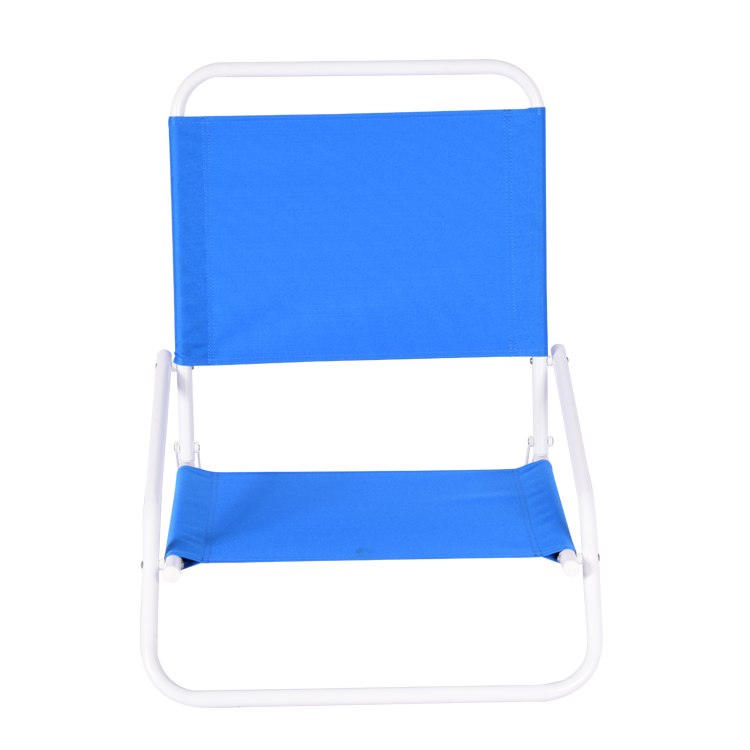
A folding beach chair is designed to sit on soft, uneven, and shifting sand. Unlike a chair on a hard floor, a beach chair's legs sink into the sand. The sinking depth depends on the leg surface area and the user's weight. A standard aluminum beach chair with round tube legs (19 mm diameter) sinks 5–10 cm into dry sand under an 80 kg person. This sinking tilts the chair backward. To compensate, many beach chairs have legs that are wider apart (60–70 cm front-to-back) than indoor chairs (45–55 cm), or they have splayed legs (angled outward) to increase the footprint. Some chairs have "sand shovels" (flat plastic or metal plates at the bottom of each leg) that distribute weight over a larger area (20–40 cm² per leg instead of 3–5 cm²). A chair with sand shovels sinks 2–4 cm, significantly less than a chair without them. For very soft, dry sand (like dunes), even sand shovels may not prevent sinking; the user must dig a shallow depression (5–10 cm deep) where the chair will sit, then place the chair in the depression. This technique is common among experienced beachgoers.
Reclining positions and back support.
Folding beach chairs typically offer 2–5 reclining positions, from upright (90 degrees) to nearly flat (135–150 degrees). The mechanism is a sliding bracket or a locking pin on each side of the chair. When the user leans back, the bracket moves along a track and locks into a notch. The notches are spaced 10–20 degrees apart. The most upright position (90–100 degrees) is for sitting at a table (beachside dining) or for reading. The mid-recline (110–120 degrees) is for conversation or watching the waves. The full recline (130–150 degrees) is for napping. However, on sand, a fully reclined chair tends to sink at the front legs (because the user's center of gravity shifts backward). This causes the chair to tip over backward if the rear legs are not long enough or if the chair lacks a stabilizing bar. Some beach chairs have an extra-long rear leg or a "tilt prevention bar" that extends behind the chair. For safe full recline, the chair should be placed with the rear legs on a firmer surface (wet sand near the waterline) or used with a "sand anchor" (a small board that attaches to the rear legs).
Armrests, cup holders, and accessory features.
Most folding beach chairs include fabric or padded armrests (height 15–25 cm from the seat). Armrests help the user push up from the chair when exiting (an important feature for older adults or anyone with knee issues). The armrests should be at least 5 cm wide to distribute pressure. Many chairs also have a cup holder (a mesh pocket or a rigid plastic ring, 7–10 cm diameter) on the right or left armrest. The cup holder is for water bottles or canned drinks (330–500 mL). It will not securely hold a stemmed wine glass or a tall 1 L water bottle (the bottle may tip out). Some chairs have a detachable or built-in "cooler pouch" (insulated vinyl) on the back of the seat or under the seat. The pouch holds 2–6 cans but is not leak-proof; melted ice will drip onto the sand or onto the user's back. A zippered storage pocket (for keys, sunscreen, phone) is common; the pocket should be placed on the side of the seat or on the back of the chair (not under the seat, where it would sit in wet sand).
Selection Criteria for Folding Beach Chairs
Frame material and corrosion resistance – aluminum vs. steel.
The frame is the most important factor for durability. Aluminum (6061 or 6063 grade, 19–25 mm diameter tubing) is the standard for beach chairs because it does not rust. Aluminum chairs weigh 2.5–4.0 kg, depending on the thickness (wall thickness 0.8–1.2 mm). A 0.8 mm wall is lighter but dents more easily; stepping on a tube (e.g., when the chair tips over) will create a dent (2–3 mm deep) that weakens the frame. A 1.2 mm wall is heavier but more durable. Aluminum frames are usually anodized or powder-coated (60–100 µm thickness) to prevent galvanic corrosion from saltwater. Even anodized aluminum will show pitting after 3–5 years of weekly beach use if not rinsed with fresh water. Steel frames (powder-coated, 1.0–1.5 mm wall) are less common for beach chairs because they rust. A steel chair used for one season (10 beach trips) without rinsing will show rust spots (red-brown dots) at welded joints and where the coating is scratched. After 2 seasons, the rust may compromise the folding mechanism. Steel chairs are heavier (4–6 kg) and less expensive. If you choose a steel chair (for budget reasons), you must rinse it with fresh water and dry it after each beach use.
Fabric type and UV resistance – what to look for.
The seat and back are made of polyester fabric (600D to 1200D denier) or Textilene (a PVC-coated polyester mesh). Polyester fabric is durable (tensile strength 300–500 N per cm) and resists tearing, but it absorbs water. A polyester seat can take 1–2 hours to dry after a dip in the ocean. Mesh (Textilene) does not absorb water; it dries in 10–15 minutes. Mesh also allows sand to fall through (instead of collecting on the seat). The downside: mesh does not provide as much insulation against cold wind; a mesh chair on a breezy 18°C day feels colder than a solid fabric chair. For UV resistance, look for fabric labeled "UV-stabilized" or "Solution-dyed polyester" (the color is added to the liquid polymer before spinning, not dyed onto the surface). Solution-dyed fabric resists fading for 3–5 years of outdoor use; surface-dyed fabric may fade noticeably after 1–2 summers. The UV stabilizer additive (usually Hindered Amine Light Stabilizer – HALS, 0.5–2% by weight) slows degradation. Without stabilizer, polyester loses 20–30% of its tensile strength after 500 hours of UV exposure (about 3 months of daily beach use).
Portability and folded dimensions – fitting in your car.
A folding beach chair must be compact enough to carry and fit in a car trunk. The folded dimensions vary. A classic "low beach chair" (seat height 15–20 cm) folds to a long, narrow package (approximately 80–90 cm long, 15–20 cm wide, 10–15 cm thick). This fits in any sedan trunk. A "high beach chair" (seat height 45–55 cm, like a standard dining chair) folds to a thicker package (80–90 cm long, 20–25 cm wide, 20–25 cm thick). This may not fit in a small car trunk (e.g., Mini Cooper, Fiat 500) unless the back seat is folded down. The folded size is determined by the length of the longest tube (usually the back frame). Some chairs have a "telescopic" back frame that shortens by 20–30 cm when folded. Check the specifications: "folded dimensions 85 × 15 × 15 cm" means length × width × thickness. Measure your trunk space before buying. Also consider weight: a 4 kg chair is noticeably heavier to carry over sand than a 2.5 kg chair. For elderly users or anyone with shoulder issues, a 2.0–2.5 kg chair is advisable.
Load capacity and structural integrity.
The load capacity (maximum user weight) is printed on the chair's label or packaging. Most beach chairs are rated for 100–150 kg (220–330 lbs). Do not exceed the rated capacity; the chair may collapse. The weakest points are the hinge rivets (where the frame folds) and the plastic armrest joints. Rivets are typically aluminum or stainless steel (3–4 mm diameter). A rivet loaded beyond its shear strength (about 150–200 N per mm² for aluminum) will pull through the frame tube. For users over 100 kg, look for chairs with steel reinforced rivets (4–5 mm diameter) or welded joints (no rivets). The seat fabric also has a load limit; the fabric is sewn to the frame with webbing loops. The webbing (polyester, 25–50 mm width) should have stitching with nylon thread (bonded, UV-resistant). A single line of stitching is weaker (150–200 N load before tearing) than a double line (300–400 N). Inspect the stitching before purchasing; loose or skipped stitches indicate poor quality.

-
-
 TEL:
TEL:
- +86-13738961469
-
-
-
 EMAIL:
- cnds@cndsgm.com
-
-
-
 ADDRESS:
- Niubei Jincun, Baiyang Sub-district, Wuyi County, Jinhua City, Zhejiang Province, China
-
Outdoor Leisure Products Manufacturer

